

Featured image alt text:
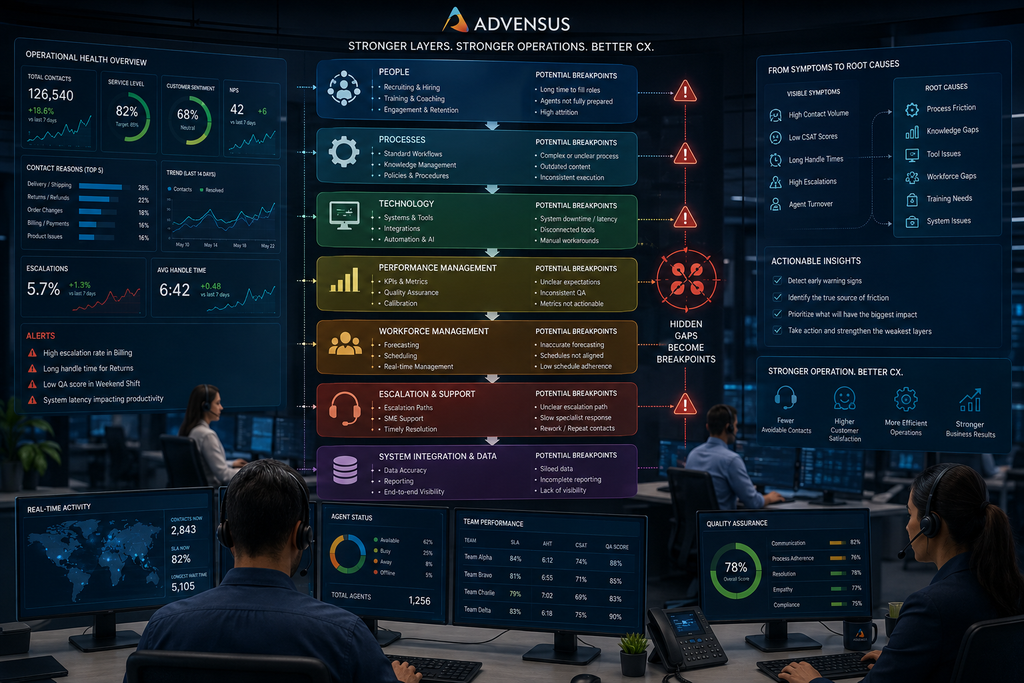
Customer experience operation represented by stacked layers with one unstable section affecting the structure.
Recommended internal links:
- Customer Care Services
- Contact Center Quality Assurance
- Workforce Management
- Nearshore Contact Center Services
- Retail and eCommerce Support
- FinTech Customer Support
- Book an Operational Assessment
The Weakest Layer: How to Find Hidden Breakpoints in Your CX Operation
Customer experience operations rarely fail all at once.
Performance usually begins to decline inside one part of the operation. Training becomes inconsistent. Quality reviews stop identifying meaningful trends. Escalations take longer. Staffing no longer matches contact demand. Agents work across systems that do not share the same information.
Each issue may appear manageable on its own. Together, they can produce longer wait times, repeated contacts, inconsistent answers and declining customer satisfaction.
The challenge is that many of these weaknesses remain hidden while service levels still appear acceptable.
A contact center operational assessment helps leaders identify those breakpoints before they become visible to every customer.
What is an operational breakpoint?
An operational breakpoint is a process, capability or dependency that becomes unreliable under pressure.
During normal volume, the weakness may have little visible impact. When demand increases, policies change or experienced employees leave, the same weakness can begin affecting performance across the operation.
For example, agents may rely on supervisors to approve exceptions because escalation authority is not clearly defined. During a normal week, supervisors can respond quickly. During a seasonal spike, approval requests accumulate and resolution times increase.
The visible problem is slow service. The underlying breakpoint is unclear decision authority.
Finding the difference between the symptom and the cause is one of the main purposes of an operational assessment.
Why dashboards do not tell the complete story
Contact center dashboards are necessary, but they usually report results rather than explain them.
A dashboard may show:
- Higher average handle time
- Lower first contact resolution
- More escalations
- Declining quality scores
- Increased abandonment
- Lower customer satisfaction
These indicators confirm that something changed. They do not always show what caused the change.
A rise in average handle time could come from more complex customer issues. It could also result from a new system, an incomplete knowledge base, slow supervisor responses or unclear procedures.
The metric is the starting point, not the diagnosis.
A useful operational assessment combines performance data with interaction reviews, employee feedback, workflow observation and process documentation.
The six layers that should be assessed
Most customer experience operations depend on six connected layers. A weakness in one can affect the others.
1. Recruiting and workforce readiness
The first question is whether the operation is hiring the right people for the work they are expected to perform.
A strong staffing plan considers language skills, communication ability, technical knowledge, schedule availability and the complexity of customer interactions.
Common warning signs include:
- New hires leave during training
- Hiring standards change when demand increases
- Certain shifts remain understaffed
- Teams depend heavily on overtime
- Experienced agents handle most difficult contacts
- Recruitment cycles cannot support growth plans
The assessment should compare hiring profiles with actual job requirements. It should also review time to hire, training completion, early attrition and performance during the first 90 days.
Staffing quantity matters. Staffing suitability matters just as much.
2. Training and knowledge management
Training is often evaluated by completion rate. That does not confirm whether employees are ready to handle real customer situations.
A training assessment should examine whether agents can locate information, apply policies and make sound decisions when the interaction does not follow a standard script.
Review:
- Training materials and simulations
- Time spent in practical exercises
- Knowledge checks
- Nesting and transition support
- Access to current policies
- Updates after product or process changes
- Coaching during the first months of production
Knowledge management deserves separate attention.
Agents may have completed effective training but still struggle because policies are spread across multiple documents, updates are difficult to find or the knowledge base does not match current procedures.
When agents cannot trust the information available to them, they rely on memory, peers or supervisors. That creates inconsistency.
3. Quality assurance and coaching
Quality assurance should identify patterns that affect customers and business results.
A weak QA program often focuses on scoring individual interactions without connecting those scores to repeat contacts, complaints, compliance risk or customer satisfaction.
Questions to ask include:
- Does the scorecard reflect the outcomes that matter?
- Are interactions selected using a consistent method?
- Do evaluators interpret standards in the same way?
- Are calibration sessions held regularly?
- Does coaching address specific behaviors?
- Are recurring issues shared with operations and training?
- Can the company connect QA findings with customer results?
An agent may receive a high quality score while the customer contacts the company again the next day. If the scorecard does not capture incomplete resolution, it may reward an interaction that created more work.
Quality assurance should improve the operation, not simply produce a score.
4. Workforce management
Workforce management connects customer demand with available capacity.
An operation may have enough employees overall and still perform poorly because schedules do not align with actual contact patterns.
Review forecast accuracy by day, hour, channel and contact type. Compare the plan with actual volume, average handling time, shrinkage, absenteeism and schedule adherence.
Look for signs such as:
- Voice service levels are protected while messaging backlogs grow
- Agents are scheduled when demand is low
- Overtime has become routine
- Supervisors spend most of the day handling escalations
- Breaks and coaching sessions are regularly cancelled
- Staffing plans do not account for product launches or campaigns
A workforce plan should also include scenarios for unusual demand.
It is not enough to forecast the most likely outcome. Leaders should know what happens when volume is 10%, 20% or 30% above expectations.
5. Escalation and decision authority
Escalations are necessary when an issue requires specialized knowledge, additional authority or another department.
They become a breakpoint when ownership is unclear.
An escalation review should track:
- Which issues are escalated most often
- How long cases wait for a response
- Which teams receive them
- Whether customers receive updates
- How often cases return to the original agent
- Whether the same issue could have been resolved at the frontline
Many escalations are created by policy rather than complexity.
Agents may understand the correct resolution but lack authority to issue a credit, correct an account or approve an exception. Every unnecessary handoff increases effort for the customer and the operation.
The assessment should identify decisions that can be safely moved closer to the frontline, supported by clear limits and quality controls.
6. Technology and process integration
Technology should reduce customer effort and help employees make better decisions.
In practice, agents often work across several systems that display different information.
A customer may see one delivery estimate while the agent sees another. A payment may appear completed in one system and pending in another. A case may be transferred without its history.
These gaps create delays and inconsistent answers.
Review the complete process from the agent’s perspective:
- How many systems are required?
- Which information must be copied manually?
- Where does the agent wait for a system response?
- What customer history is lost between channels?
- Which tasks require support from another team?
- Where are errors most likely to occur?
Technology assessments should not focus only on software features. They should evaluate how the systems affect real interactions.
How to conduct the assessment
A practical operational assessment can be completed in four stages.
Establish the baseline
Begin with three to six months of performance data.
Review contact volume, service levels, abandonment, average handle time, first contact resolution, repeat contacts, transfers, escalations, QA results, CSAT, staffing and attrition.
Segment the data by channel, team, contact reason and time period. Company-wide averages may hide a serious issue inside one group or process.
Review customer interactions
Select a sample of calls, chats, emails and cases from the largest contact reasons and lowest-performing areas.
Include successful interactions as well as difficult ones.
The review should identify:
- Where the customer became confused
- How long the agent searched for information
- Whether the customer repeated information
- Where transfers occurred
- Whether commitments were completed
- Whether the issue was fully resolved
Interaction reviews provide context that performance reports cannot.
Speak with frontline employees
Agents, supervisors and quality analysts often understand operational weaknesses before leadership sees them in a report.
Ask what prevents them from resolving issues, which policies create confusion, what customers complain about most and which system steps add unnecessary work.
Their feedback should be validated with data, but it should not be dismissed because it is informal.
Repeated employee observations often point to a process that deserves closer review.
Prioritize the findings
Not every issue requires immediate investment.
Score each finding according to:
| Factor | Question |
| Frequency | How often does the issue occur? |
| Customer impact | How much effort or frustration does it create? |
| Business impact | Does it affect cost, retention, revenue or compliance? |
| Operational risk | Could the issue become worse during growth or disruption? |
| Effort | How difficult is it to correct? |
A common issue with high customer impact and a simple correction should be addressed quickly.
A less frequent issue may still require immediate action when it creates financial, compliance or reputational risk.
What the final assessment should produce
The final deliverable should not be a general list of observations.
Each finding should include:
- The operational issue
- Evidence supporting the finding
- The customer and business impact
- The likely root cause
- The recommended action
- The responsible owner
- A completion date
- A metric to confirm improvement
Some actions may take only a few days. Examples include updating a knowledge article, adjusting a routing rule or clarifying an escalation path.
Others may require a larger project, such as redesigning training, integrating systems or changing the staffing model.
The value of the assessment comes from establishing a practical sequence of improvements.
Frequently asked questions
How often should a CX operational assessment be conducted?
A complete assessment should usually take place at least once a year. Additional reviews are useful after rapid growth, a major system change, a new product launch, a decline in customer satisfaction or a change in outsourcing partner.
Is an operational assessment the same as a quality audit?
No. Quality assurance is one part of the operation. A broader assessment also reviews recruiting, training, staffing, technology, escalation, governance and process design.
Should outsourced teams be included?
Yes. An outsourced partner should provide performance data, workforce information, quality findings, employee feedback and examples of recurring customer issues. The partner should also participate in the corrective plan.
Strengthen the operation before pressure exposes it
Operational weaknesses become more expensive when they are discovered through customer complaints, missed service levels or lost business.
A structured assessment gives leaders an earlier view.
It shows where teams are losing time, where customers are encountering unnecessary effort and which operational layer requires attention first.
Advensus helps companies evaluate customer experience operations, identify hidden performance gaps and build flexible nearshore teams designed for reliability, continuity and measurable improvement.
Book an Operational Assessment.
