

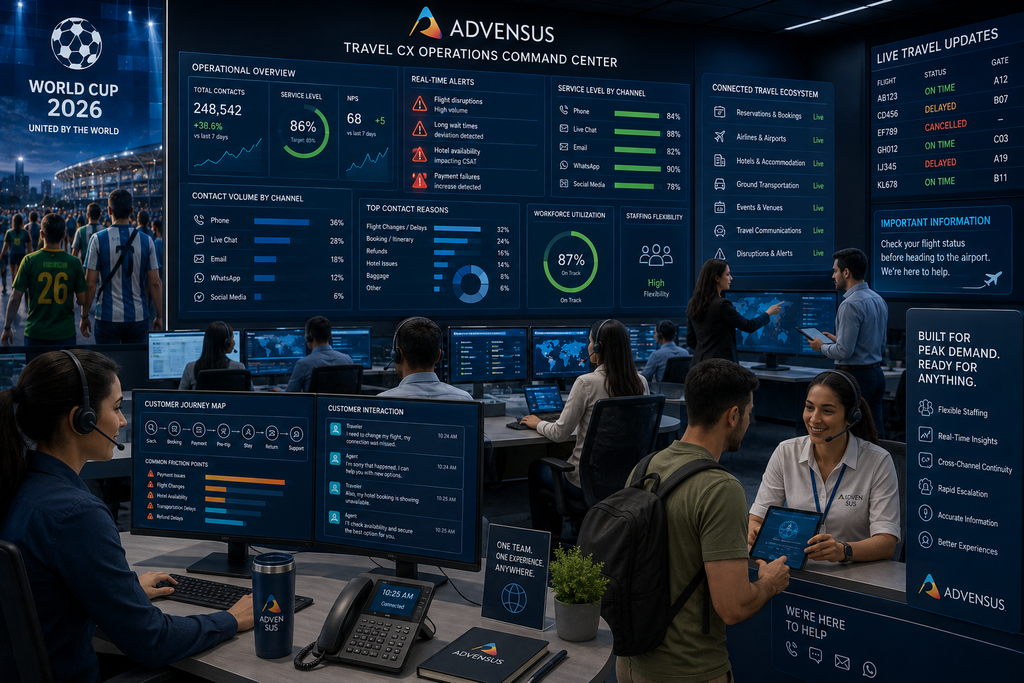
World Cup 2026: What Travel Brands Can Learn From a Global Customer Support Stress Test
The 2026 World Cup created a rare test for the travel and hospitality industry.
The tournament brought 48 teams and 104 matches to 16 host cities across Canada, Mexico and the United States. By the end of the round of 16, FIFA reported more than 6.25 million match attendees, with 99.7% of available seats filled.
Those numbers represent far more than stadium attendance. Each fan journey may involve flights, hotels, vacation rentals, booking platforms, ground transportation, restaurants and local attractions.
Every reservation creates a service expectation. Every change creates a potential support interaction.
For travel brands, a global event of this size reveals whether customer support operations can manage high contact volume, changing information and time-sensitive problems without losing consistency.
Why major events create unusual customer service pressure
Travel support becomes more complex when customers are moving through several cities, countries and service providers.
A delayed flight may affect a hotel check-in. A schedule change may require new transportation. A payment issue may prevent a traveler from accessing a booking made months earlier.
The customer sees one trip. The companies involved often see separate transactions.
This creates a difficult support environment. Agents may need to interpret policies, verify information across systems and coordinate with another department or external provider while the customer is under time pressure.
The U.S. Travel Association found that international World Cup visitors expected to spend more than $5,000 per person, about 1.7 times the spending of a typical international trip to the United States. One-third planned to stay longer than two weeks, and more than 80% were open to visiting destinations beyond the largest gateway cities.
Longer stays and multi-city itineraries increase both commercial opportunity and operational complexity.
The customer remembers the disruption
Most travelers expect a normal booking process to work.
Their opinion of a brand is often shaped when something does not.
A cancelled flight, lost reservation or missed connection creates an immediate need for information. The customer wants to know what happened, what options are available and who is responsible for solving the problem.
During that moment, several details influence the experience:
- How quickly support can be reached
- Whether the agent has complete information
- Whether the customer must repeat the situation
- Whether the agent can make a decision
- Whether updates arrive without another contact
- Whether the final resolution matches what was promised
A travel company may not control the original disruption. It does control how clearly and effectively it responds.
Five areas every travel support operation should review
The World Cup provides a useful framework for evaluating customer support during any large event, including conventions, festivals, holiday periods and major sporting competitions.
1. Contact demand and event timing
Traditional forecasting based on monthly or weekly averages may not capture event-driven demand.
Travel brands should map expected contact volume against match schedules, arrival periods, departure windows, local events and known transportation constraints.
Demand may rise before a match as travelers confirm reservations and transportation. A second increase may occur immediately afterward as large groups leave the same area.
The forecast should account for each contact channel. Voice may increase during urgent disruptions, while messaging and social media may absorb status inquiries.
Questions for the review include:
- When did volume exceed the forecast?
- Which contact reasons increased first?
- Which cities or properties generated the most demand?
- Did one channel develop a backlog while another remained stable?
- How quickly could staffing be adjusted?
The objective is to understand the relationship between the event schedule and customer behavior.
2. Information consistency
Travel information changes quickly during large events.
Hotel availability, departure times, local transportation, access restrictions and cancellation policies may be updated throughout the day. Agents need a reliable source of current information.
When different channels display different answers, customer effort increases.
A traveler may receive one response from a chatbot, another from an agent and a third from the company’s mobile application. Even when each response was accurate at the time, the experience feels unreliable.
Support leaders should review:
- How information was updated
- Who approved operational changes
- How quickly updates reached frontline employees
- Whether chat, voice, email and self-service used the same source
- How outdated information was removed
- Whether agents could see the time of the latest update
A knowledge base should function as an operational tool, not simply a library of articles.
3. Cross-channel continuity
Customers often change channels when a situation becomes urgent.
A traveler may begin with self-service, move to chat and then call when the issue remains unresolved. Each transition should preserve the context of the previous interaction.
Without continuity, the customer must start again.
Review whether agents can see:
- Previous conversations
- Reservation details
- Promises made by another agent
- Documents already submitted
- Current case ownership
- The status of an escalation
Cross-channel visibility is especially important when support is distributed among internal teams, outsourced partners and external service providers.
The customer should not need to understand the company’s organizational structure to receive help.
4. Frontline authority and escalation
Some travel problems require immediate decisions.
An agent may need to approve a rebooking, waive a fee, issue a credit or protect a reservation affected by a delay. If every exception requires supervisor approval, cases accumulate during the busiest periods.
The operational review should identify which decisions could be safely handled by frontline employees.
Clear authority limits can reduce transfers and resolution time while maintaining financial and quality controls.
Escalations that remain necessary should have:
- A defined owner
- A response target
- A clear priority level
- Complete customer history
- A process for customer updates
- A method for confirming completion
An escalation is not complete when the case is transferred. It is complete when the customer receives a resolution.
5. Workforce flexibility
Major events rarely follow the most likely forecast exactly.
Weather, security incidents, transportation failures and match results can change customer behavior within hours.
The staffing model should include contingency plans for different demand levels.
This may involve cross-trained agents, flexible schedules, reserve capacity and nearshore teams that can extend coverage without requiring a completely separate operating structure.
The assessment should examine:
- Forecast accuracy
- Schedule adherence
- Overtime
- Absenteeism
- Agent occupancy
- Supervisor availability
- Backlog by channel
- Time required to add capacity
A workforce plan that depends on continuous overtime may protect service levels temporarily, but it can also increase fatigue and quality risk.
Metrics that show whether the operation remained stable
Total contact volume does not explain support performance by itself.
Travel brands should review metrics that connect customer demand with resolution quality.
| Metric | What it helps reveal |
| Contacts per reservation | Whether support demand increased faster than bookings |
| First contact resolution | Whether customers received a complete answer |
| Repeat contact rate | Whether customers needed to return for the same issue |
| Transfer rate | Whether routing or ownership was unclear |
| Escalation response time | Whether urgent cases received timely attention |
| Abandonment rate | Whether customers could reach support |
| Backlog age | Whether unresolved cases remained after demand declined |
| CSAT by contact reason | Which disruptions caused the greatest dissatisfaction |
| Rebooking completion time | How quickly affected customers received an alternative |
| Complaint rate | Whether service failures became formal complaints |
Metrics should be segmented by city, property, route, language, channel and contact reason where possible.
Company-wide averages may appear stable while one destination or customer group experiences serious problems.
What travel brands should audit after the event
A post-event review should combine operational data with examples from actual customer interactions.
The audit should answer:
- Which disruptions generated the most contacts?
- Which contacts could have been prevented with better communication?
- Where did customers receive conflicting information?
- Which issues required repeated contacts?
- Which decisions caused unnecessary escalation?
- Where did staffing fail to match demand?
- Which systems prevented agents from seeing the complete journey?
- Which changes should be completed before the next major event?
Agents and supervisors should participate in this process. They often see recurring problems before those issues are clear in executive reporting.
The final audit should assign an owner, deadline and success measure to every approved action.
Preparation should begin before demand arrives
Large events expose weaknesses that already exist.
Unclear policies become inconsistent answers. Limited system access creates longer interactions. Slow escalation processes become backlogs. Staffing gaps become abandoned contacts.
The most effective preparation happens before reservations and customer questions begin to increase.
Travel and hospitality companies should complete a readiness review that covers:
- Contact volume scenarios
- Staffing and cross-training
- Knowledge management
- Escalation authority
- Multilingual support
- System access
- Proactive notifications
- Business continuity
- Quality monitoring
- Communication with external partners
The plan should also define what will happen when actual conditions differ from the forecast.
Frequently asked questions
What is a travel customer support stress test?
A travel customer support stress test evaluates whether staffing, systems, policies and escalation processes can remain effective during unusually high demand or widespread disruption.
Which travel companies should conduct one?
Airlines, hotels, booking platforms, vacation rental providers, transportation companies and destination service businesses can all benefit from the process.
How far in advance should planning begin?
Planning should begin several months before a known event. Workforce recruitment, training, system changes and partner coordination may require more time than schedule adjustments or communication updates.
Can outsourcing help with event-driven demand?
A flexible contact center partner can provide additional capacity, extended coverage and specialized support. The model works best when the partner has access to current information, clear decision authority and shared performance standards.
The larger lesson from World Cup 2026
The scale of the 2026 World Cup made travel disruption more visible, but the operational lessons apply throughout the year.
Customers need fast, accurate and coordinated support whenever their plans change.
A reliable customer experience operation connects staffing, information, technology and decision-making. It gives frontline teams the tools and authority to solve problems while giving leadership enough visibility to manage risk.
Advensus helps travel and hospitality brands build flexible customer support operations that can respond to changing demand without sacrificing service quality or operational control.
Schedule a Travel CX Operations Review.
