

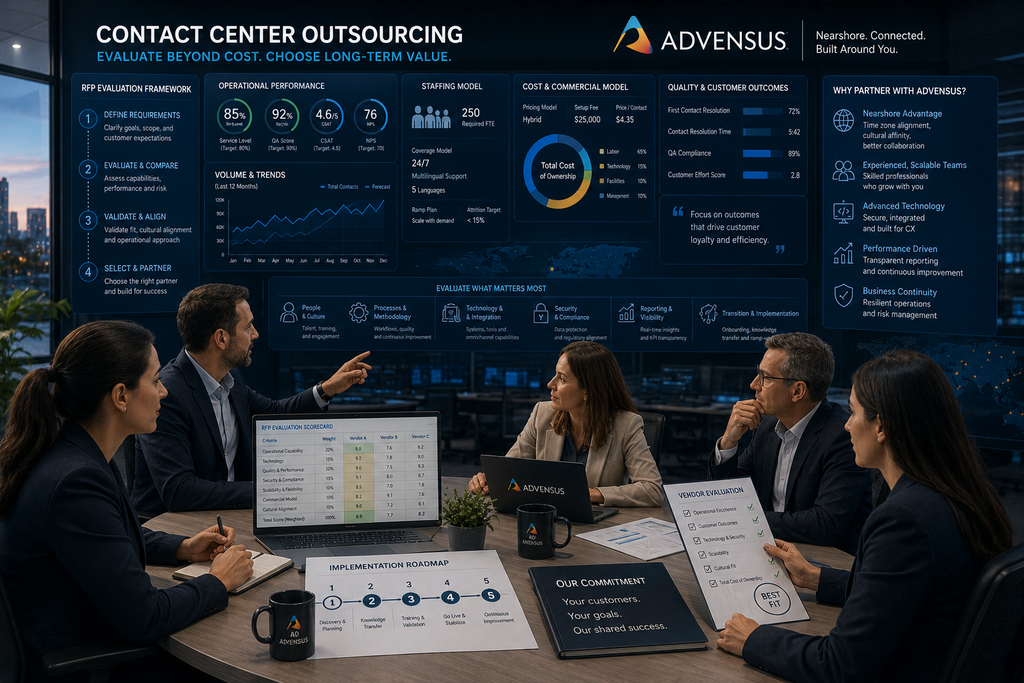
A contact center request for proposal should help a company identify the provider most capable of delivering reliable customer outcomes.
Too many RFPs focus heavily on price, seat capacity and general company information. Those details matter, but they do not show how a provider recruits, manages quality, responds to change or takes ownership when performance declines.
A stronger RFP evaluates the complete operating model.
That includes people, processes, technology, security, governance, implementation and the provider’s ability to support the customer experience over time.
Start with the business need
Before sending an RFP, the buying team should define the problem it is trying to solve.
Common objectives include:
- Reducing domestic operating costs
- Improving service levels or customer satisfaction
- Adding capacity for growth
- Replacing an underperforming provider
- Extending support hours
- Supporting seasonal demand
- Accessing specialized skills or languages
- Moving from offshore to nearshore operations
- Creating business continuity across multiple locations
The RFP should explain the current situation, expected outcomes and constraints.
A provider cannot design a useful solution when the document only requests a rate per agent.
Include the customer segments, contact channels, service hours, major contact reasons, estimated volumes and performance challenges. Explain whether the provider will handle the complete operation or work alongside an internal team.
Build the evaluation team
Contact center outsourcing affects more than procurement.
The evaluation team should include representatives from:
- Customer experience
- Operations
- Procurement
- Finance
- Information technology
- Information security
- Legal and compliance
- Workforce management
- Quality assurance
- Human resources, when relevant
Each group should define what it needs to evaluate before the RFP is released.
Procurement may focus on commercial terms. Operations may prioritize staffing and governance. Security may require specific controls and documentation.
Creating the criteria in advance reduces the risk of changing the scoring process after proposals arrive.
1. Relevant experience
Providers should demonstrate experience with the type of operation being outsourced.
Ask for details about:
- Industries currently supported
- Similar customer profiles
- Contact channels managed
- Program size and complexity
- Languages supported
- Regulatory or compliance experience
- Average client relationship length
- References from comparable accounts
General contact center experience is not always enough.
A provider supporting basic retail inquiries may not be prepared to manage financial disputes, complex technical support or sensitive healthcare interactions.
Ask the provider to describe relevant use cases, not simply list industries on a slide.
Useful questions include:
- What similar programs do you currently operate?
- What were the main operational challenges?
- How was performance measured?
- What changed after implementation?
- Can the client provide a reference?
The objective is to understand whether the provider has solved a comparable problem.
2. Recruiting and workforce availability
The RFP should test whether the provider can recruit the right employees within the required timeline.
Request information about:
- Recruiting sources
- Candidate screening
- Language and communication testing
- Background checks
- Time to hire
- Training completion rates
- Early-stage attrition
- Seasonal hiring capacity
- Availability by shift
- Workforce demographics relevant to the program
Ask the provider to explain how the hiring profile will be created for your account.
A general statement about access to a large labor market does not confirm that qualified candidates are available.
The response should show how the provider validates skills, manages hiring surges and adjusts the recruitment plan when results fall below expectations.
3. Training and knowledge management
Training should prepare employees to make decisions, not only memorize scripts.
The RFP should ask providers to describe:
- Curriculum development
- Product and process training
- Systems training
- Role-play and simulations
- Knowledge checks
- Certification requirements
- Nesting and production transition
- Refresher training
- Coaching after launch
- Knowledge-base management
Clarify which training responsibilities belong to the client and which belong to the provider.
Ask how updates will be communicated when policies, products or systems change.
A provider should also explain how it measures training effectiveness. Completion rates alone do not show whether agents are ready for customer interactions.
4. Quality assurance
Quality assurance should connect agent behavior with customer and business outcomes.
Request details about:
- Quality scorecards
- Sampling methods
- Evaluation frequency
- Calibration sessions
- Coaching processes
- Compliance monitoring
- Dispute procedures
- Reporting
- Root-cause analysis
- Continuous improvement
Ask how the provider adjusts the QA program for different contact types.
A sales interaction, fraud complaint and technical support case should not necessarily use the same scorecard.
The provider should also explain how quality findings are shared with training, operations and workforce management.
A QA program has limited value when it produces scores but does not drive action.
5. Workforce management
Workforce management determines whether the right number of employees are available when customers need help.
The RFP should request information about:
- Forecasting methods
- Scheduling
- Real-time management
- Intraday adjustments
- Schedule adherence
- Shrinkage assumptions
- Overtime controls
- Absence management
- Multichannel planning
- Seasonal capacity
- Contingency staffing
Provide historical volume data when possible. Ask each provider to explain how it would build the staffing plan.
The response should identify assumptions, risks and the amount of flexibility available when demand exceeds the forecast.
A credible provider should be willing to discuss limitations rather than promise unlimited capacity.
6. Technology and integration
The technology section should reflect the actual operating environment.
Clarify whether the provider will use:
- Client-owned systems
- Provider-owned platforms
- A combination of both
- Virtual desktop access
- Secure browser-based tools
- Telephony and routing provided by the client
- Omnichannel platforms managed by the provider
Ask about:
- CRM integration
- Call recording
- Screen recording
- Reporting
- Workforce management tools
- Quality platforms
- Knowledge management
- Authentication
- Data retention
- Disaster recovery
- Technical support
The provider should describe how agents will access customer information and how system problems will be escalated.
Technology should support the operating model. It should not be treated as a separate feature list.
7. Security and compliance
Security questions should be specific to the data and interactions involved.
Depending on the program, evaluate:
- Physical security
- Access controls
- Device restrictions
- Data-loss prevention
- Network security
- Encryption
- Background screening
- Incident response
- Business continuity
- Privacy processes
- PCI-related controls
- HIPAA requirements
- Industry-specific regulations
Ask for relevant certifications, audit reports and policy documentation.
The review should also cover how incidents are reported, who participates in the response and how quickly the client is notified.
Do not rely only on a provider’s general statement that it is secure or compliant.
8. Governance and operational ownership
Governance determines how the client and provider will work together after launch.
Ask providers to propose a meeting and reporting structure that includes:
- Daily operational management
- Weekly performance reviews
- Monthly business reviews
- Quarterly strategic reviews
- Escalation paths
- Corrective-action plans
- Change management
- Executive sponsorship
- Risk tracking
- Continuous improvement
The RFP should distinguish between reporting a problem and taking ownership of it.
A provider may deliver accurate dashboards without offering recommendations. A stronger partner identifies patterns, investigates root causes and proposes action.
Ask for an example of a performance issue the provider identified and corrected without waiting for the client to direct every step.
9. Implementation and transition
The implementation plan should show how the provider will move from contract signing to stable operations.
Request a proposed timeline covering:
- Discovery and solution design
- Technical setup
- Recruiting
- Training development
- Hiring and training
- Testing
- Quality calibration
- Go-live
- Stabilization
- Final transition into normal governance
Ask the provider to identify dependencies on the client.
These may include system access, training materials, subject-matter experts, policy approval and security reviews.
A realistic timeline should show what could delay the launch and how the provider would manage those risks.
10. Business continuity
Every proposal should include a continuity plan.
Evaluate:
- Backup power
- Redundant internet
- Alternate work locations
- Remote-work capability
- Emergency communication
- Data recovery
- Staffing continuity
- Geographic concentration
- Testing frequency
- Recovery targets
Ask when the continuity plan was last tested and what the test revealed.
A written plan is not enough. The provider should demonstrate that the procedures are current, practical and understood by the people expected to use them.
Providers operating across more than one country or site may offer additional flexibility, but the RFP should confirm how work would move between locations during a disruption.
11. Pricing and commercial structure
Pricing should be easy to compare, but it should not be reduced to a single hourly rate.
Request a complete breakdown of:
- Agent labor
- Team leadership
- Quality assurance
- Workforce management
- Training
- Recruiting
- Technology
- Facilities
- Implementation
- Overtime
- Holidays
- Currency adjustments
- Volume changes
- Early termination
- Additional services
Ask which costs are included and which may be billed separately.
The evaluation should consider the total operating cost, not only the lowest rate.
A lower price can become more expensive when the model requires additional client management, creates high attrition or produces more repeat contacts and escalations.
12. Cultural and partnership fit
Some parts of the evaluation cannot be captured entirely in a spreadsheet.
Meet the leaders who would manage the account. Ask how decisions are made, how problems are communicated and how executive leadership remains involved.
Consider:
- Transparency
- Responsiveness
- Communication style
- Flexibility
- Willingness to challenge assumptions
- Ease of doing business
- Leadership access
- Alignment with company values
The team presenting the proposal should not be the only team the buyer meets.
Request conversations with operations, recruiting, training, quality, workforce management and implementation leaders.
The people responsible for delivery are more important than the sales presentation.
A practical RFP scoring model
A weighted scoring model helps prevent price from dominating the decision.
| Evaluation area | Suggested weight |
| Relevant experience | 10% |
| Recruiting and workforce | 10% |
| Training and knowledge | 10% |
| Quality assurance | 10% |
| Workforce management | 10% |
| Technology and integration | 10% |
| Security and compliance | 10% |
| Governance and ownership | 10% |
| Implementation and continuity | 10% |
| Pricing and commercial fit | 10% |
The weights should be adjusted to reflect the program.
A FinTech operation may assign more weight to security and compliance. A seasonal retail program may prioritize scalability and workforce flexibility.
The scoring model should be completed before proposals are reviewed.
Warning signs in an outsourcing proposal
Common warning signs include:
- Generic answers that do not address the program
- Pricing without clear assumptions
- Aggressive ramp-up promises without a recruiting plan
- Limited access to operational leaders
- Few relevant client references
- Weak explanation of corrective-action processes
- Security claims without documentation
- Dependence on one location
- No clear transition ownership
- Little discussion of risks or limitations
A proposal that avoids difficult questions may create more uncertainty after the contract is signed.
Frequently asked questions
How long should a contact center RFP process take?
A typical process may take several weeks, depending on the number of providers, security requirements, site visits and contract complexity. Rushing the evaluation can create a longer and more expensive transition later.
How many providers should receive the RFP?
A focused group of three to five qualified providers is often easier to evaluate than a large list. Initial market research should remove companies that do not match the location, experience or scale required.
Should pricing be included in the first round?
Yes, but the pricing format should be standardized. Providers should state assumptions so the buying team can identify differences in staffing, leadership, technology and included services.
Is an RFP always necessary?
Not always. A smaller or less complex program may use a structured request for information followed by workshops and a detailed proposal. The same evaluation criteria should still apply.
Choose the operating model, not only the vendor
A contact center RFP should help buyers understand how each provider will recruit, train, manage and improve the operation.
The strongest proposal is not always the one with the lowest rate or the most polished presentation.
It is the one that demonstrates a credible plan, transparent assumptions, relevant experience and clear ownership of customer outcomes.
Advensus works with mid-market and emerging enterprise companies that need flexible nearshore customer experience operations across the Dominican Republic and Trinidad & Tobago.
Our approach is built around close collaboration, operational visibility and solutions designed for the needs of each program.Talk to a Nearshore Operations Expert.
