

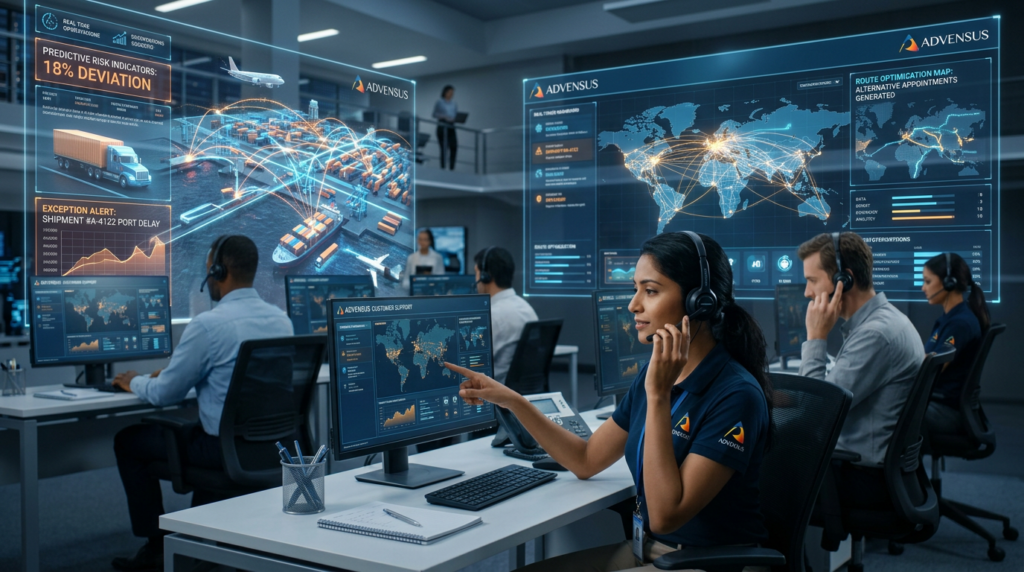
Logistics customer experience is no longer just about moving goods from point A to point B. It is about visibility, communication, exception management and trust.
Customers expect to know where a shipment is, why a delay happened, what the next step is and who can help when something goes wrong. For logistics providers, distributors, retailers and supply chain teams, customer support has become a critical part of operational performance.
AI and analytics can improve this experience, but they cannot replace the need for trained human support. The future of logistics customer experience will be built on a hybrid model: technology for visibility and speed, humans for judgment, communication and problem resolution.
Supply Chains Are Still Operating in a Volatile Environment
Logistics teams continue to operate in a complex environment shaped by cost pressure, trade policy shifts, labor challenges, cybersecurity risk and changing customer expectations.
The 2025 Supply Chain Stability Index from ASCM and KPMG describes continued volatility across trade policy, labor markets and global sourcing. KPMG’s 2025 supply chain trends also highlights the need for supply chain leaders to manage cost, risk, technology adoption and resilience.
This volatility affects customer experience directly. When supply chains are disrupted, customers do not only want internal explanations. They want clear communication, proactive updates and realistic timelines.
That is where logistics support teams become essential.
Where AI and Analytics Improve Logistics CX
AI and analytics can help logistics companies make service more proactive and less reactive.
Useful applications include:
Shipment visibility
Analytics can help teams identify delays, bottlenecks and status changes earlier. This allows companies to update customers before they contact support.
Exception detection
AI can help identify shipments at risk, unusual delivery patterns, documentation gaps or recurring service issues.
Forecasting support volume
Historical data can help predict when customer inquiries will rise because of seasonal demand, weather events, supplier delays or operational disruptions.
Faster routing and prioritization
AI can classify support tickets, identify urgency and route inquiries to the right team faster.
Agent assistance
AI can summarize customer history, suggest next steps, surface shipment details and help agents respond more consistently.
DHL’s Logistics Trend Radar highlights the growing role of technologies such as advanced analytics, generative AI and AI ethics in logistics operations. Gartner also named agentic AI, ambient invisible intelligence and the augmented connected workforce among the top supply chain technology trends for 2025.
The direction is clear: logistics teams are becoming more data-driven. But technology alone does not solve the customer experience problem.
Why Human Support Still Matters
A customer does not judge a logistics company only by whether a shipment is late. They judge the company by how clearly the issue is explained and how quickly someone helps resolve it.
Human support remains critical when the situation requires:
- Explaining a complex delay
- Coordinating between carriers, warehouses and customers
- Handling frustrated clients
- Resolving documentation issues
- Supporting high-value accounts
- Managing claims or service failures
- Communicating realistic next steps
- Protecting long-term relationships
AI can detect the issue. Analytics can show the pattern. But human agents often have to manage the conversation.
This matters because logistics problems can affect revenue, inventory planning, customer promises and downstream operations. A delayed response can create more than frustration; it can create business consequences for the customer.
The New Logistics CX Model
A stronger logistics support model should combine data, automation and human service.
1. Proactive communication
Customers should not have to chase updates. Support teams should use shipment data and analytics to communicate delays, exceptions and next steps before the customer asks.
2. Clear ownership
When an issue involves multiple parties, the customer still wants one clear point of contact. Logistics support teams should reduce confusion, not pass the customer from department to department.
3. Smart escalation
High-value customers, urgent shipments, repeated delays, claims and service failures should move quickly to trained agents or account teams.
4. Better back-office coordination
Many logistics issues are not solved on the phone. They require documentation, data updates, order corrections, carrier coordination and internal follow-up.
5. Human agents supported by AI
AI should help agents work faster and more accurately, but it should not remove human judgment from sensitive or high-impact interactions.
Why Nearshore Support Fits Logistics Operations
Logistics support often requires speed, flexibility and communication across time zones. Nearshore support can help companies manage high-volume inquiries, back-office tasks and customer communication without relying only on expensive domestic staffing.
Advensus is a nearshore contact center with operations in the Dominican Republic and Trinidad & Tobago, supporting clients across North America with customer care, collections, technical support and back-office services. Advensus’ ideal customer profile includes logistics companies, especially organizations with high volumes of customer interactions, inbound and outbound engagement needs, high domestic labor costs, inconsistent QA or pressure to improve CSAT, AHT, NPS and FCR.
Advensus also supports multichannel service through inbound voice, outbound voice, chat, back-office support and social media, with a delivery model built around flexibility, quality management, workforce management, reporting and scalable staffing.
For logistics companies, this combination is valuable because customer experience depends on both operational information and human follow-through.
Final Thought
The logistics customer experience is becoming more data-driven, but it is still relationship-driven.
AI can help predict problems. Analytics can reveal patterns. Automation can accelerate routing and updates. But when a shipment is delayed, a customer is frustrated or a high-value account needs answers, human support still matters.
The strongest logistics companies will not choose between technology and people. They will build service models where AI improves visibility, analytics improves decision-making and trained human agents protect trust.
Advensus helps logistics and supply chain companies scale customer care, shipment inquiry support, back-office processing and multichannel communication with nearshore teams built for flexibility, quality and operational follow-through.
